A compliant digital capital and commerce architecture connecting real assets, operating cash flows, and measurable impact with bGATE Crypto Token.
Real assets & legal rights first _ Verified performance
Purpose of this paper. This white paper describes proposed technology, governance, and legal architecture. It is not an offer to sell, a solicitation to buy, or a recommendation concerning any token, security, note, equity interest, or other financial instrument.
bGate ecosystem token or project-specific RWA security is not offered by this paper. Propositions will be made only through definitive legal framework to eligible investors only, required disclosures, investor-eligibility procedures, and a legally permitted distribution channel in each applicable jurisdiction. Participants must consult with the issuer if desiring the fractional ownership of the RWA and to receive dividends/revenue incentives. KYC/due diligence is mandatory by law in such cases.
Approved fractional owners of RWA may receive the rights expressly granted in the offering documents, such as:
A blockchain record does not by default create an ownership or fractional ownership of the plant or commodities or other RWA placed on blockchain by the issuer and participants must not assume right to project revenues without KYC, due diligence and approvals received by the issuer. Token holder rights arise from the governing instrument, the issuer's constitutional documents, subscription agreement, security documents, KYC approvals and the applicable law.
Technical descriptions, production data, product yields, revenue possibilities, tax incentives, environmental attributes, and development schedules involve uncertainties. Every project must complete technical, legal, commercial, environmental, insurance, tax, and financial due diligence before capital is accepted or deployed.
bGATE category under FCA regulated framework is REGULATED SECURITY TOKENS. These tokens amount to a 'Specified Investment' under the Regulated Activities Order (RAO). These may provide rights such as ownership, repayment of a specific sum of money, or entitlement to a share in future profits to approved token holders. They may also be transferable securities or other financial instrument under the EU's Markets in Financial Instruments Directive II (MiFID II). These tokens are likely to be inside the FCA's regulatory perimeter.
It expressly avoids guaranteeing income, appreciation, redemption, liquidity, or recovery value and this proposition does not qualify everyone by default but refers to approved investors only.
The contents below reflect the architecture white paper. Project-specific financial terms belong in separate offering documents and supplements.
Broadgate Energy is an engineering firm, specialized in manufacturing & operations of waste-to-energy plants with Advanced Pyrolysis technology to recycle all types of mixed waste & biomass to produce biodiesel, petrol, jet fuel, kerosene, syngas and by-products as biochar, in sustainable, environmental friendly manner. Offering zero waste-to-landfill & zero emissions plant performance.
Broadgate also manufacture Green Ammonia, Bio methanol, Amine Gas purifications plants, ORC Turbines for power generation, electrolyzers to produce green hydrogen by splitting water molecules into hydrogen & oxygen and developed own hydrogen engine for cars & trucks.
bGate Digital is designed as a digital capital and commerce layer for productive real-world assets. Its purpose is to connect infrastructure owners, operators, equipment manufacturers, investors, suppliers, purchasers, communities, and service providers through legally enforceable project structures and auditable digital records.
The model begins with infrastructure that creates measurable economic output: energy plants, industrial equipment, waste-conversion systems, renewable-energy assets, commodities, and verified environmental attributes. Each financed project is placed in a legally defined project company or special-purpose vehicle (SPV). The SPV owns or controls the relevant assets, contracts, revenues, and obligations.
This structure addresses the central weakness in many token projects: the same token is often asked to be a payment instrument, a governance mechanism, an investment, a claim on multiple assets, and a freely tradable speculative instrument. bGate separates those functions so that legal rights, risks, and financial performance can be evaluated project by project.
The recommended first transaction is a narrowly defined project-specific security tied to one identified asset package, one issuer, one use of proceeds, and one reporting framework. Investor rights may take the form of secured debt, project equity, or defined revenue participation, but only as established in definitive offering documents. No return is guaranteed.
bGate's long-term objective is not to make physical assets disappear into a digital token. It is to make the relationships around those assets more transparent, standardized, accountable, and accessible while preserving the legal protections required in the physical economy.
Productive infrastructure frequently falls into a financing gap. Projects may be too small or specialized only for large infrastructure funds, too early for conventional project finance, and too complex for ordinary equipment lenders. The result is that commercially promising assets can remain idle while communities continue paying for waste disposal, imported energy, and centralized supply chains. bGATE bridges this gap, offering community access to the infrastructure projects.
The gap is not only a shortage of capital. It is also a shortage of standardized evidence. Investors need clear answers concerning title, permits, technology performance, feedstock, offtake, construction risk, insurance, operating control, cash flow, and remedies if the project underperforms. Traditional project records are often fragmented among spreadsheets, contracts, bank accounts, equipment logs, regulators, and service providers. This fragmentation raises transaction costs and makes ongoing monitoring difficult. bGate is intended to organize these records around consistent project architecture and a shared reporting standard.
The opportunity: combine conventional asset ownership and enforceable finance documents with programmable records, controlled transfers, and verified operating data.
The constraint: do not treat tokenization as a substitute for project quality, regulation, or investor protection.
The bGate response: qualify the project first, document the legal rights second, and use blockchain technology only where it adds traceability, automation, or market access.
Real-world assets, commonly called RWAs, are tangible or financial assets whose ownership, repayment rights, revenue rights, access rights, or other economic interests are represented digitally. Examples include real estate, equipment, energy facilities, commodities, receivables, bonds, and environmental instruments.
Tokenization is the process of creating a digital representation of an asset or financial instrument using distributed-ledger technology. The legal effect depends on the structure. A token may be the security itself, may record an entitlement maintained by an issuer or transfer agent, or may merely provide a technical means of notifying an off-chain register. The U.S. Securities and Exchange Commission emphasized in January 2026 that token format does not change the application of federal securities laws.[1]
| Benefit | Practical Meaning | Important Limitation |
|---|---|---|
| Fractional Participation | A financing interest can be divided into standardized units. | Eligibility, minimums, and transfer restrictions still apply. |
| Auditability | Ownership and approved transfers can be recorded consistently. | Bad source data remains bad data; verification is required. |
| Automation | Payments, notices, and compliance rules may be encoded. | Smart contracts cannot resolve every legal dispute. |
| Potential Liquidity | Authorized holders may transfer interests through permitted channels. | No market or buyer is guaranteed. |
| Lower Friction | Standardized records can reduce reconciliation and administration. | Regulated intermediaries, auditors, insurers, and counsel remain necessary. |
bGate therefore uses the term asset-linked rather than automatically asset-backed. A project security is backed only to the extent that definitive documents create enforceable rights to identified assets, cash flows, guarantees, reserves, or collateral.
bGate's vision is an independent, transparent ecosystem in which capital can be connected to productive infrastructure and measurable real-world results. The ecosystem is intended to distribute opportunities more broadly while keeping project economics anchored in operating assets rather than token speculation.
The revised architecture separates a general ecosystem instrument from project financing instruments. The two may operate on compatible technical infrastructure, but they have different issuers, rights, compliance rules, and economic purposes.
| Feature | bGate Ecosystem Token | Project-Specific RWA Security |
|---|---|---|
| Primary Purpose | Payments, access, services, rewards, and ecosystem participation. | Finance a defined asset or project through debt, equity, revenue participation, or another documented security. |
| Issuer | A designated bGate ecosystem entity, after legal review. | The applicable project SPV or financing issuer. |
| Economic Rights | No plant equity, project income, revenue share by default/automatically, or promised yield. | Only the rights stated in the offering and governing documents. |
| Asset Link | Fractional ownership claim over bGate projects. | Identified project assets, obligations, or cash flows as legally documented. |
| Supply | Not finalized in this architecture paper; disclosed in a later token addendum. | Determined separately for each offering and reconciled to its capitalization. |
| Transferability | Subject to platform rules and applicable law. | Whitelisted and restricted by securities law, offering terms, and venue rules. |
| Investor Expectation | Designed for consumptive utility & passive profit. | A regulated investment with illiquidity risk. |
The ecosystem token will not automatically convert into a project security, and a project security will not automatically convert into the ecosystem token. Any exchange between them must be a separately permitted transaction with pricing, identity, agreement suitability and legal controls.
Each project must be legally understandable without the blockchain. The digital layer records and administers rights; it does not replace the entity, contracts, bank accounts, or remedies that make those rights enforceable.
| Participant | Core Responsibility | Required Separation or Control |
|---|---|---|
| bGate Platform Entity | Technology, onboarding standards, reporting interfaces, clarity, transparency & ecosystem administration. | Does not commingle project assets or imply ownership of every project. |
| Project SPV | Owns or controls project assets, contracts, revenues, and liabilities. | Separate books, accounts, governance, and disclosures. |
| Operating Company | Runs the facility, employs staff, maintains permits, and performs commercial contracts. | Operating obligations and service standards documented in O&M and project agreements. |
| Investors or Security Holders | Provide capital under the applicable offering terms. | Rights limited to definitive documents; no reliance on this paper for returns. |
| Regulated and Assurance Providers | KYC/AML, custody, transfer agency, banking, audit, valuation, legal, insurance, and technical verification. | Engaged as required by jurisdiction and offering structure. |
The preferred model is issuer-sponsored tokenization. The project issuer or its authorized agent maintains the master securityholder record and ensures that an approved on-chain transfer corresponds to a legally effective transfer. A purely synthetic token that only tracks an asset's value without rights against the asset owner is not the preferred bGate project model.
A project is not eligible for financing merely because it can be described as eco green, innovative, or tokenizable. It must pass a gated review designed to expose the same weaknesses that conventional lenders and infrastructure investors would examine.
Capital should be released against documented milestones, not solely against a token sale. Escrow or controlled-account procedures should link disbursements to title, shipping, delivery, installation, testing, permitting, insurance, and commissioning evidence.
bGate is intended to support multiple conventional financing rights in tokenized form. The token is the record and transfer mechanism; the underlying instrument determines the economics.
| Structure | Holder Right | Best Use | Key Risks |
|---|---|---|---|
| Secured Equipment Note | Scheduled principal and interest supported by collateral. | Identifiable machinery with documented title and value. | Recovery value, enforcement, downtime, and priority. |
| Project Debt | Contractual debt service from project cash flow. | Projects with stable feedstock, offtake, permits, and operating history. | Construction, ramp-up, coverage, and refinancing. |
| Project Equity | Residual ownership, distributions, voting, and exit rights as documented. | Risk capital able to absorb volatility and long hold periods. | Dilution, no distribution, governance, and total loss. |
| Revenue Participation | Defined percentage of specified revenues for a term or cap. | Projects with verifiable sales and controlled collection accounts. | Revenue definition, margin pressure, classification, and monitoring. |
No single project-financing form is endorsed by this white paper. The issuer, rights, priority, collateral, dilution, distributions, term, and remedies must be selected project by project after legal, financial, technical, tax, and commercial review.
Each project should be operated through a controlled bank account structure. Token holders should never depend on an informal promise that project revenue will later be allocated fairly. The waterfall must be written into the project's governing and financing documents.
Smart contracts may automate notices and distribution calculations after verified cash is available, but they should not transfer funds based solely on unverified production data. Bank balances, approved invoices, and the off-chain accounting ledger remain critical control records.
Revenue from one project must not be used to imply support for another project unless a legally documented portfolio or cross-collateralization structure expressly permits it and discloses the resulting risks. The issuer finances future projects privately through its own liquidity.
The proposed bGate platform combines an on-chain record with off-chain identity, legal, banking, and operating systems. Personal information and confidential commercial documents should remain off chain, while cryptographic proofs or document hashes can establish that an approved version existed at a specific time.
Identity layer. KYC/AML, screening sanctions, investor eligibility, wallet association, and permissions are maintained by authorized providers.
Asset layer. Title documents, security filings, valuations, contracts, and insurance identify with the legal asset package.
Token layer. Smart contracts enforce authorized issuance, holding, transfer, pause, recovery, and distribution rules.
Register layer. The issuer or transfer agent maintains the legally recognized holder record and reconciles it with on-chain balances.
Data layer. Plant systems, laboratory reports, meters, invoices, bank records, and auditors support verified performance reporting.
Settlement layer. Payments occur through lawful bank, payment, stable-value, or digital-asset channels selected for the applicable jurisdiction.
For an operating waste-to-energy project, the reporting dashboard should distinguish measured data from modeled data and disclose at least throughput, feedstock composition, uptime, planned and unplanned downtime, product output, energy imported and exported, internal or parasitic load, inventory, realized selling price, accounts receivable, maintenance, safety incidents, permit status, and material variances from budget.
Blockchain selection remains open. The selection criteria should include security, cost, institutional custody, permissioned transfer support, smart-contract maturity, privacy, interoperability, environmental footprint, and long-term maintainability. Technology neutrality prevents the project's legal rights from becoming dependent on the popularity of one network.
Broadgate electrical pyrolysis illustrates the type of productive asset bGate is intended to evaluate. The system is described as an electrically heated, oxygen-free conversion process producing condensable liquid fuels, cleaned gas & solid carbon. The preferred environmental language is closed-loop thermal recycling, Advanced Pyrolysis system with no untreated discharge, not an unqualified claim of zero emissions.
Company-provided operating materials describe approximately 35 days of continuous operation, throughput near 1,250 kilograms per hour in the stated run, and approximately 30 tons per day of plastics. Laboratory certificates supplied for liquid samples report gross calorific values of approximately 40.22 and 42.42 megajoules per kilogram.
These figures are inputs to diligence, not bGate guarantees. Before financing a commercial project, an independent engineer should verify scale, feedstock composition, continuous uptime, yield, product quality, energy balance, parasitic consumption, maintenance requirements, emissions, and replication at the intended site.
The RWA structure strengthens the technology story because it forces each plant to prove its own legal and commercial readiness. A plant should not be admitted merely because another unit has operated. The project data room must include site-specific permits, land control, feedstock agreements, product offtake, construction status, insurance, financial model, and commissioning plans. The same framework can later support other technologies and asset classes.
bGate is therefore not dependent on one reactor, one manufacturer, one site, or one revenue stream, although each early transaction must remain narrow enough for investors to understand the exact value chain.
bGate is intended to connect participants who already create or purchase real economic value. The network becomes useful when it reduces friction among them, not when participation depends primarily on token price appreciation.
| Participant | Role in the Ecosystem |
|---|---|
| Project Sponsors and Operators | Develop & operate qualifying assets; provide complete & timely disclosure. |
| Equipment and Technology Providers | Supply, warrant, commission, and maintain physical systems. |
| Investors and Finance Providers | Provide risk capital under project-specific terms and receive benefits & project reporting. |
| Feedstock and Material Suppliers | Deliver contracted inputs and document quantity, composition, and chain of custody. |
| Energy, Fuel, Material, and Credit Purchasers | Buy verified outputs under spot or contracted arrangements. |
| Communities and Public Bodies | Host infrastructure, oversee permits & operations, and evaluate local economic and environmental performance. |
| Auditors, Engineers, Laboratories, Insurers, and Counsel | Verify facts, allocate risk, maintain market integrity and produce reports for publishing. |
| Merchants and Service Providers | Accept ecosystem payments for approved goods and services. |
The bGate Ecosystem Token may eventually support access fees, approved services, participant rewards, data products, settlement, and discounts. These uses must be live, understandable, and legally reviewed before a token is sold or widely distributed.
Governance must prevent the platform sponsor, project sponsor, operator, and token treasury from becoming an indistinguishable pool. The following controls are design requirements for a credible RWA ecosystem.
The platform should publish a governance charter before launch. Project investors should receive separate governance terms for their issuer, including voting thresholds, amendment rights, manager removal, asset sales, refinancing, additional debt, dilution, defaults, and enforcement.
bGate should assume from the outset that a project token representing equity, debt, revenue participation, or profit expectation is a regulated security unless qualified counsel concludes otherwise for the relevant facts and jurisdiction. Calling the instrument a utility token, RWA, membership, or digital receipt does not control its legal classification.
In the United States, the SEC's January 2026 staff statement explains that tokenized securities remain subject to federal securities laws and that offers and sales require registration unless an exemption is available. Distribution, custody, transfer agency, broker-dealer activity, trading venues, state law, tax, the Investment Company Act & money-transmission rules may also be relevant.
In the United Kingdom, bGate must account for the financial-promotion regime and the evolving authorization framework for cryptoasset trading platforms, intermediaries, safeguarding, lending, staking, and identifiable DeFi controllers. The FCA's June 2026 policy statement states that overseas firms serving U.K. consumers may fall within the U.K. authorization perimeter for relevant activities.
Earlier FCA promotion rules also require qualifying cryptoasset promotions to be fair, clear, and not misleading and restrict how they may be communicated.
In the European Union, cryptoassets that qualify as financial instruments may fall outside MiCA's general cryptoasset regime and instead remain subject to securities and markets law. Classification must be performed before marketing or admission to trading.
This white paper is an architecture document. It must never be used in place of an offering memorandum, private-placement memorandum, prospectus, subscription agreement, note, indenture, security agreement, shareholder agreement, risk factors, or legal opinion.
| Compliance Area | bGate Design Response |
|---|---|
| Offering Route | Select registration or exemption before any solicitation or sale; document jurisdiction and investor class. |
| KYC/AML and Sanctions | Verify identity, beneficial ownership, source controls, sanctions, and transaction monitoring through qualified providers. |
| Financial Promotions | Use approved, balanced communications with prominent risks; avoid incentives or claims prohibited in the target market. |
| Custody and Safeguarding | Use legally permitted custody and segregation arrangements; disclose key, insolvency, and recovery risks. |
| Transfers and Trading | Whitelist wallets, enforce holding and eligibility restrictions, and use authorized venues or transfer processes where required. |
| Data and Privacy | Keep sensitive identity data off-chain; comply with applicable privacy, retention, and cybersecurity duties. |
| Tax and Accounting | Obtain issuer, investor, asset, and token accounting and tax analysis for every jurisdiction. |
This revision intentionally does not announce a final supply, public-sale price, exchange listing, or allocation for the bGate Ecosystem Token. Publishing arbitrary tokenomics before legal classification, platform utility, technical design, treasury controls, and demand modeling would create avoidable regulatory and economic risk.
The recommended sequence is to operate the early bGate platform using conventional payment channels and project-specific securities. A separate token issuance addendum may be published only after real consumptive uses exist and counsel has reviewed the design.
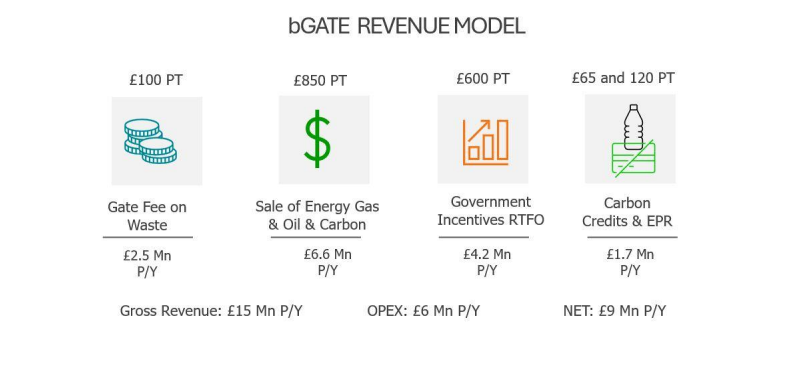
| Revenue Stream | Rate | Per Year |
|---|---|---|
| Gate Fee on Waste | £100 PT | £2.5 Mn |
| Sale of Energy, Gas & Oil & Carbon | £850 PT | £6.6 Mn |
| Government Incentives RTFO | £600 PT | £4.2 Mn |
| Carbon Credits & EPR | £65 and £120 PT | £1.7 Mn |
Gross Revenue: £15 Mn P/Y | OPEX: £6 Mn P/Y | NET: £9 Mn P/Y
Tokenization can improve transfer administration, but it does not create a market. A holder may be unable to sell a project security for an extended period or at any acceptable price. Every offering must disclose this risk prominently. bGATE may offer buyback guarantees to approved participants.
Project-security transfers should require approved wallets, identity checks, eligibility confirmation, compliance with holding periods, issuer consent where applicable, and synchronization with the recognized holder register. Transfers may occur only through legally permitted bilateral processes or authorized trading venues.
The platform should not promise 24/7 liquidity. Even where a technical network operates continuously, market hours, venue access, settlement, pricing, disclosures, buyer demand, lockups, and regulatory restrictions can limit actual trading.
Any issuer repurchase, redemption, refinance, or liquidity facility must be separately funded and documented. It should not be implied by the word asset-backed or by the existence of an operating plant. DeFi integration is not a launch feature. Use of project securities as collateral, automated market-making assets, or lending instruments should be considered only after counsel, custody providers, venues, and project investors approve a compliant structure.
bGate's environmental claims must be as disciplined as its financial claims. A project can create local energy & emissions benefits without supporting every possible sustainability statement.
Environmental revenue should enter a project financial model only when eligibility, methodology, ownership, registration, verification, issuance timing, pricing, and buyer access are supportable. It should be separated from base operating revenue in downside analysis unless contracted.

bGate should launch through readiness gates rather than a calendar-driven token sale. Each gate produces evidence needed by the next.
| Gate | Objective | Minimum Exit Evidence |
|---|---|---|
| Legal Architecture | Define platform entity, project issuers, jurisdictions, instruments, and regulated-service needs. | Counsel-approved structure memo, compliance map, entity authorities, and document list. |
| Pilot Project Readiness | Select one financeable asset and complete data-room review. | Title, site, permits, budget, feedstock, offtake, insurance, financial model, and independent technical scope. |
| Financing Readiness | Prepare the selected project-specific security. | Definitive term sheet, offering documents, escrow, KYC/AML, custody/register, and milestone draw controls. |
| Commissioning and Reporting | Deploy capital and verify the physical asset. | Delivery, installation, acceptance tests, permits, insurance, and live reporting. |
| Platform MVP | Operate holder records, reporting, notices, and controlled distributions. | Security audit, reconciliation, recovery procedures, privacy controls, and operational service providers. |
| Controlled Transfer Capability | Enable legally permitted transfers for eligible holders. | Venue or bilateral process, whitelist controls, disclosures, and register synchronization. |
| Ecosystem Token Decision | Determine whether a general token adds real utility. | Live use cases, legal classification, token addendum, supply and allocation, treasury charter, and technical audit. |
The recommended pilot is narrow: one project, one issuer, one instrument, one defined use of proceeds, and one reporting package. A successful pilot creates the standards for later projects; an overly broad first launch multiplies legal, technical, and execution risk.
Participation in an early-stage infrastructure and digital-asset platform involves substantial risk, including the possibility of total loss. The following summary is not exhaustive and does not replace project-specific risk factors.
| Risk Category | Examples | Primary Mitigation Direction |
|---|---|---|
| Project Development | Permits, land control, construction, shipping, installation, commissioning, cost overruns. | Milestone draws, contingency, fixed scopes, independent inspection, and insurance. |
| Technology and Operations | Scale-up, yield, feedstock variation, downtime, parasitic load, maintenance, safety. | Independent engineering, acceptance tests, reserves, O&M standards, and transparent reporting. |
| Commercial | Feedstock loss, product quality, price volatility, offtaker default, credit timing. | Contracts, counterparty review, multiple markets, conservative cases, and working capital. |
| Financial | Insufficient cash flow, leverage, dilution, refinancing, currency, tax, valuation. | Coverage tests, reserves, covenants, sensitivities, independent tax and valuation work. |
| Legal and Regulatory | Security classification, promotion, licensing, custody, sanctions, privacy, tax change. | Jurisdictional counsel, regulated providers, controls, monitoring, and restricted access. |
| Digital and Cyber | Smart-contract bugs, key loss, wallet compromise, oracle error, network disruption. | Audits, pause/recovery controls, segregation, multi-approval custody, and incident response. |
| Liquidity and Market | No trading venue, few buyers, transfer restrictions, price manipulation. | No liquidity promise, controlled venues, disclosures, surveillance, and long-hold suitability. |
| Environmental and Reputational | Unsupported claims, credit double counting, emissions event, community opposition. | Measured claims, third-party verification, permit compliance, and stakeholder engagement. |
Project structures can allocate risk or provide mitigation but cannot eliminate it completely. Collateral may be difficult to enforce or may be worth less than expected. Insurance may exclude or limit losses. Smart contracts may behave as coded while the underlying project fails. bGATE aims to provide clarity and transparency regarding risks and benefits at all stages.
bGate Digital's opportunity is larger than launching a coin. It is the opportunity to build a disciplined bridge between capital, real productive assets, local economic participation, and verifiable performance. The revised architecture gives every instrument one clear pathway. bGate Ecosystem Token supports commerce & participation. Project-specific RWA securities finance defined assets through legally documented rights. Environmental instruments remain separately verified. Project SPVs preserve accountability. The platform provides common standards, records, controls, and reporting. This structure does not remove the hard work of infrastructure — it makes that work visible. Permits, feedstock, offtake, engineering, insurance, construction, operations, cash management, and investor protection remain the foundation.
With this approach, bGate can pursue a global RWA ecosystem without confusing community participation with securities ownership or confusing technical transferability with guaranteed liquidity. That clarity is the basis for trust and responsible scale.
bGATE Tokenization is to support:
bGATE Success Criteria:
Corporate and Governance
Site, Equipment, and Technical
Commercial and Regulatory
Financial and Offering
| Term | Definition |
|---|---|
| Asset-linked | A digital instrument connected by enforceable documents to identified assets, obligations, cash flows, or rights; not a guarantee of value or recovery. |
| bGate Ecosystem Token | A proposed instrument for approved commerce, access, services, and participation; not a pooled ownership interest in bGate projects. |
| Project-Specific RWA Security | A security issued for a defined project or assets to approved participants with rights established by its definitive documents. |
| Project SPV | A special-purpose entity that owns or controls the applicable project assets, contracts, revenues, and liabilities. |
| Master Securityholder Record | The legally recognized record of security ownership, maintained by the issuer or authorized agent. |
| On-chain | A record or transaction processed on a blockchain or comparable distributed ledger. |
| Off-chain | A record or process maintained outside the blockchain, including identity, contracts, banking, and accounting. |
| RWA | Real-world assets, such as waste-to-energy plants, properties or gas & oil, gold, silver & copper commodities, or financial rights represented and administered digitally. |
| Tokenization | Creation of a digital representation of a tangible or intangible asset or financial instrument using distributed-ledger technology. |
| Whitelisting | A control that permits a token to be held or transferred only by approved addresses or persons. |
[1] U.S. Securities and Exchange Commission, Division of Corporation Finance, Division of Investment Management, and Division of Trading and Markets, Statement on Tokenized Securities, January 28, 2026.
[2] U.K. Financial Conduct Authority, PS26/11: Regulated Cryptoasset Activities, June 2026.
[3] U.K. Financial Conduct Authority, PS23/6: Financial Promotion Rules for Cryptoassets, updated February 6, 2026.
[4] Broadgate Energy / Broadgate electrical pyrolysis operational-data materials supplied for project diligence. Company-provided source; independent verification required.
[5] Certificates of analysis and mass-and-energy-balance materials supplied for Broadgate project diligence. Company-provided sources; site-specific verification required.
[6] Regulation (EU) 2023/1114 on Markets in Crypto-assets (MiCA), May 31, 2023.
END OF WHITE PAPER